The Premier League title has predominantly been won by European managers since 1992



Over the years, the Premier League has seen an increase in stakes and competitiveness. Players from diverse corners of the earth have graced what many consider the most competitive and arguably the best league in the world.
And just as players from many countries have journeyed from some of the coldest and hottest parts of the world to make the league the “most competitive league”, playing some of the most beautiful football, pleasing to the eyes of viewers all over the world, it has also attracted some of the most astute or elite managers in the world.
Despite this, towering figures of the English football managerial list, for all their brilliance, have never quite crossed into the grandest folklore in the Premier League era.
So why has this been the English manager’s recurring story? Walk with me…
Read more: FIFA Club World Cup: European dominance, South American decline & a changing landscape
It’s a curious paradox. The Premier League is often hailed as the most competitive and glamorous league in the world. A roaring engine of global football. Yet when it comes to producing managers capable of conquering the league, English managers seem to stall just short of the finish line.
The Premier League has evolved into the most demanding business model in world football — a league shaped by vast financial muscle, relentless intensity, and a global audience that averages over 40,000 spectators per game.
Its pace and physical demands set it apart from rivals like La Liga and Serie A, Bundesliga, and Ligue 1, with players routinely hitting top speeds of 32.5 km/h, creating a game that is not just fast but unforgiving — literally “punishable by death” with the slightest blink of an eye.
In such a high-pressure, high-tempo landscape, the margins for error shrink — and the challenge for managers, particularly those trying to rise within it, becomes significantly steeper.
For years, English football has been built around intensity, directness, and physical dominance. The traditional English approach rewarded quick transitions, high-tempo attacking play, aggressive pressing, and a reliance on individual moments rather than prolonged tactical control.
Managers are often judged by mentality, motivation, and adaptability more than by intricate positional systems.
That style once defined the identity of English football, but the modern Premier League has evolved into something far more tactical and calculated.
The arrival of elite European coaches, such as Jose Mourinho, Arsene Wenger, Antonio Conte, Carlo Ancelotti, etc., has gradually shifted the balance of power.
Managers such as Pep Guardiola introduced a philosophy centred on structure, positional discipline, controlled possession, and tactical manipulation of space.
Jürgen Klopp also brought an organised pressing system built on synchronised movement and tactical intensity rather than chaos. Even figures like Thomas Tuchel and Mikel Arteta have leaned heavily into continental concepts focused on control, flexibility, and game management.
In contrast, many English managers have historically remained more attached to the league’s traditional rhythm — reactive football, fast vertical play, and emotional momentum.
While those qualities can still produce competitive teams, they have increasingly struggled to match the tactical sophistication and consistency demanded to win league titles over a 38-game season.
The difference is not necessarily one of intelligence or coaching quality, but of football education and tactical evolution. European managers often arrive having worked within deeply structured coaching systems where tactical identity is developed over years.
Many English coaches, meanwhile, developed in a football culture that prioritised intensity and experience over tactical innovation.
As the Premier League became more strategic and globally influenced, clubs at the top have increasingly favoured managers capable of controlling games rather than simply competing in them.
That shift has allowed European coaches to thrive, while English managers have often found themselves trying to adapt to a league that no longer favours the traditional English approach in the same way it once did.
English football created the Premier League’s identity, but modern Premier League football increasingly resembles a globally accepted competition played at English speed.
Ultimately, the Premier League’s evolution may have unintentionally created an environment where the modern European football philosophy is better suited to sustained title success — and until English coaching fully evolves alongside it, the gap at the very top could remain difficult to close.
During this phase, the league’s “Rolls-Royce” evolution has failed to accelerate the pace, as no English manager has won the Premier League since Howard Wilkinson led Leeds United to the Football League First Division title in the 1991–92 season, just before it was rebranded as the Premier League.
Since the Premier League began in 1992, 12 managers have won the title, with Sir Alex Ferguson leading with 13 titles. Pep Guardiola has won six with Manchester City, while Jose Mourinho and Arsène Wenger both won three.
Other winners include Kenny Dalglish, Carlo Ancelotti, Roberto Mancini, Manuel Pellegrini, Claudio Ranieri, Antonio Conte, Jürgen Klopp, and Arne Slot.
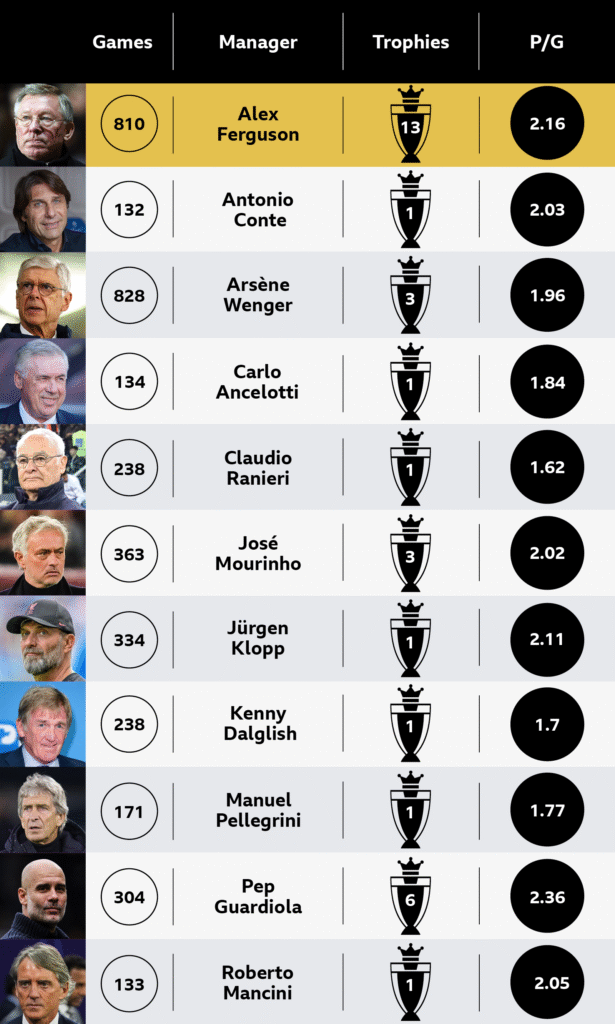
Sir Kenny Dalglish won the Premier League as a manager, leading Blackburn Rovers to the title in the 1994/95 season, after taking over the club in the second tier in 1991, and brought them to the top flight, and went on to win the championship.
It was Blackburn’s first title in over 80 years, becoming one of the few managers to win the top-flight title with two different clubs, although his Liverpool titles were prior to 1992.
The best finish for any English manager since the top division era has been second, but none have finished first in the Premier League era. The vast divide in the gap for such an unwanted record sharply undermines the growth of the English game over the years, without a notable English name enshrined in the historic scrolls of the elite league.
Consequently, the demand for instant success could be an unflinching factor that has determined the failure of both past and present English managers to prove their worth in an all-time demanding landscape that harbours no failure and takes no passengers.
That intensity has quietly reshaped the pathway for managers in the Premier League. Clubs operating at the highest level are no longer willing to develop coaches over time; instead, they lean towards proven winners with established identities, often sourced from abroad.
The result is a cycle where English managers rarely get the time, resources, or margin for error required to build title-winning sides.
But the question beckons: Are they trusted enough to manage a big squad, given the financial toolkits and a harmonious environment to work in?!
The likes of Steven Gerrard, Frank Lampard, who guided Coventry to Premier League qualification, Graham Potter, Eddie Howe, and Liam Rosenior have shown enough potential in a demanding profession that rewards success but punishes managers with an exit notice.
In a league that demands immediate impact and tactical accuracy at the highest level, experience is prioritised over potential, and not even the flair of the English language delivery can save you — and that has consistently worked against homegrown coaches.
In the recent history of the Premier League, a clear pattern emerges. Title success has been dominated by elite, internationally proven managers such as Pep Guardiola, Jürgen Klopp, and previously José Mourinho, Antonio Conte, and Carlo Ancelotti.
These are coaches who arrived with established philosophies, major honours, and the authority to immediately shape elite squads, making them world-beaters and talk of the morning matters.
In contrast, English managers have largely been tasked with stabilising projects rather than leading title challenges, often stepping into clubs with limited resources or long-term rebuilding goals.
Does that mean they are not good enough for the top jobs? Are they built to be “project stabilisers” rather than competitors at the highest level?
The gap is not simply one of ability, but of opportunity and positioning within the league’s hierarchy.
It would be easy — and wrong — to suggest that English managers lack the quality to compete. Coaches such as Eddie Howe and Graham Potter have shown tactical intelligence, adaptability, and the ability to improve teams.
Howe’s work in transforming Newcastle United into a competitive force is a clear example of what English managers can achieve with the right structure and backing.
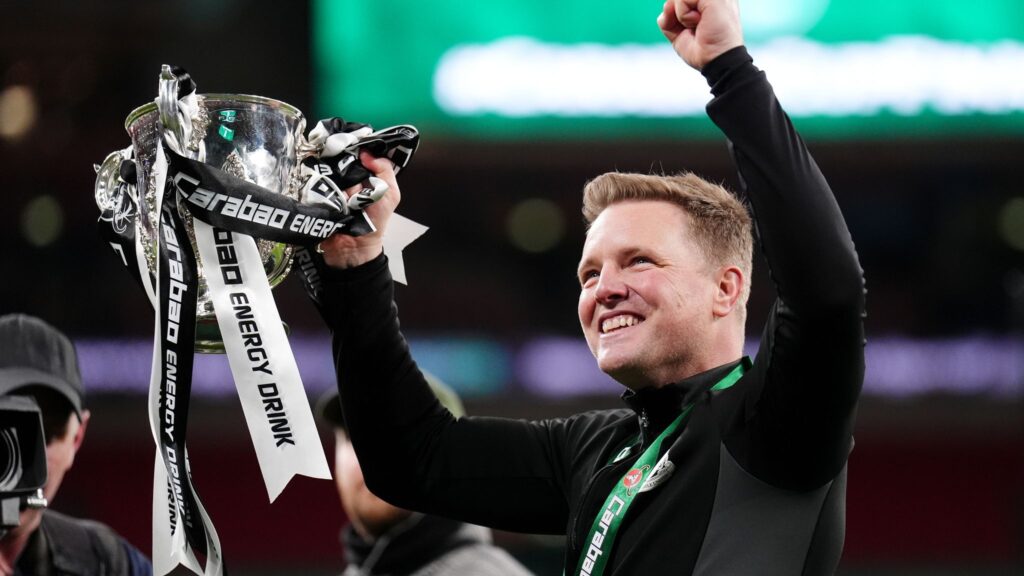
While cementing his place, arguably, at the highest echelon of the managerial pedestal after winning the EFL Cup (Carabao Cup) in the 2024/2025 season — a victory that marked the club’s first major domestic trophy in 70 years, featuring a 2–1 win over Liverpool in the final in March 2025.
In today’s game, Eddie Howe confidently stands as a modern standard-bearer at club level, yet even he remains some distance from lifting the Premier League.
The most significant contrast lies in opportunity, and not in their ability. English managers are often tasked with building or stabilising teams, not inheriting ready-made title contenders. The jump from progress to dominance is where the gap truly emerges.
At its core, the issue is more structural than trust. The Premier League has become a league where risk is minimised at the highest level. Owners and decision-makers favour experience over potential, and having a higher ceiling for instant success, especially when the financial and competitive stakes are so high.
This creates a perpetual cycle: No English manager wins the title — fewer or none are trusted with elite squads — the chances of winning remain limited, and to some extent increasingly insurmountable. Breaking into that cycle is arguably harder than winning the title itself.
Think of it like a world-class theatre that imports its leading actors while its homegrown talent watches from the wings. The stage is magnificent, the audience global, but the spotlight rarely falls on English managerial voices.
Until that cycle shifts, the absence of an English title-winning manager is likely to continue. It is not simply a question of talent, but of timing, trust, and access to the very top.
In the most competitive league in world football, the door is not closed to English managers — but it is narrower, extremely scrutinised, heavier, and to some extent, a more tedious task of guiding a thin thread through the tiny eye of a sewing needle, which requires extreme precision, and is far more difficult to push open.
Remarkably, no English manager has ever won the Premier League in its modern era. Quite astonishing, isn’t it? That absence raises an uncomfortable question: how can a nation that built such a powerful football ecosystem struggle to produce the very leaders needed to dominate it?
So the question lingers… why does England, with all its resources and prestige, still search for a manager to both own its domestic crown and leave a lasting mark on Europe’s grandest stage?
Read more: Five things you need to know about the FIFA Club World Cup